.png)
Before a drug candidate can advance, researchers need to answer the question: does this molecule actually bind to its target, and how tightly?
The answer is critical. A weak binder that dissociates during sample prep will never yield a clean structure. A candidate with a slow off-rate has a fundamentally different therapeutic profile than one with a fast on-rate and comparable affinity. These distinctions shape decisions about which compounds to advance, which to drop, and whether a complex is stable enough to take to the microscope.
For most virtual biotechs and small companies, getting rigorous binding data has meant tracking down the right instrumentation, coordinating logistics, and hoping for useful guidance along the way. Now, NIS/Proteos can help you answer these questions quickly.
Two Techniques, One Goal: Quantitative Binding Data
Both SPR and BLI are label-free biophysical methods. What they share is the ability to measure binding interactions in real time and extract three numbers that matter enormously for drug discovery: the association rate (kon), the dissociation rate (koff), and the equilibrium affinity (KD). Together, these tell you not just whether binding occurs, but how fast, how tightly, and how long a molecule stays bound. This information shapes every decision downstream.
Where they differ is in how they work and what they’re best at.
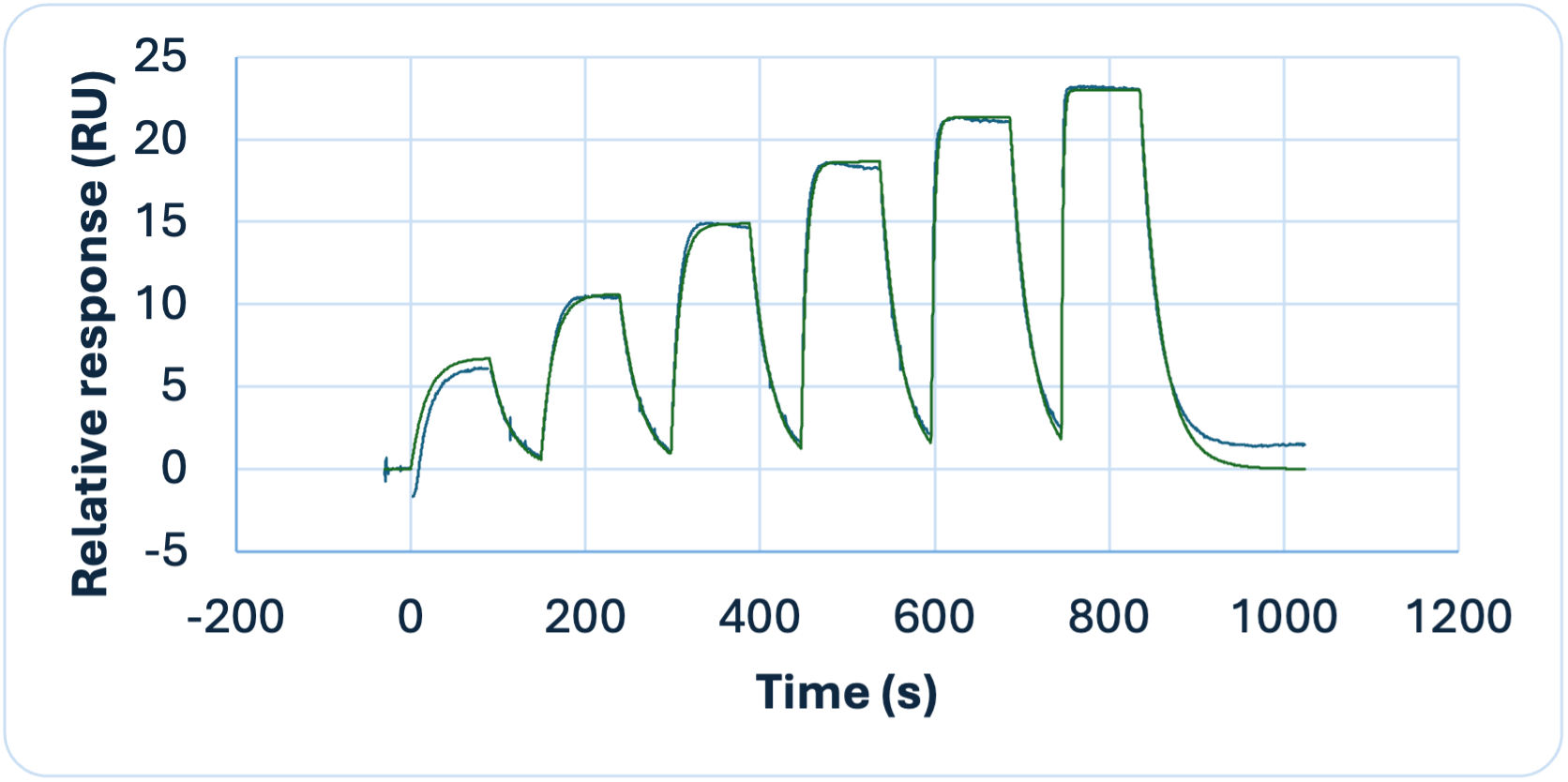
For SPR, the protein target is immobilized on a sensor chip surface, and the drug candidate or ligand flows across it in a microfluidic system. When binding occurs, it shifts the refractive index at the chip surface and generates a sensorgram in real time. SPR’s key strength is sensitivity: it can detect the small mass changes that occur when small molecules bind a protein, making it the method of choice for small-molecule drug programs where precision is non-negotiable.
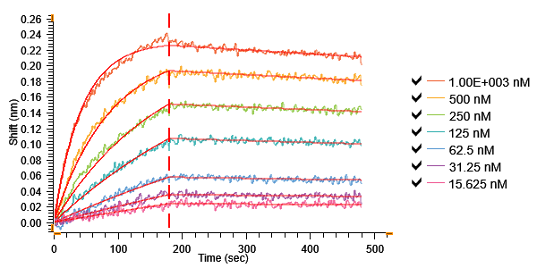
BLI uses disposable biosensor tips dipped into wells containing your analyte rather than a fluidic system. As binding occurs, the optical thickness at the tip changes, shifting an interference pattern and generating a real-time signal. BLI is faster to set up, requires no fluidics, and works well even with complex or partially purified samples, making it a natural fit for protein–protein interactions, antibody–antigen binding, and kinetic ranking of biologic candidates.
Neither technique is universally better. The right choice depends on your molecule type, the questions you need to answer, and where you are in the program. And sometimes the answer is both.
Who This Is For
If you’re a virtual biotech or small-to-mid-sized company developing antibodies, biologics, or small molecules, and you don’t have SPR or BLI instruments in-house, this is for you.
You already know what these measurements mean and why they matter. What you’ve needed is a reliable, expert partner who can generate them quickly and on demand, without your project competing for time against other priorities.
That’s what we’ve built.
Our Approach
We engage collaboratively from the start: assay strategy, immobilization optimization, concentration ranges, and interpretation are all part of the conversation. You're not handing off samples to a black box, you're working with a team that cares whether the experiment actually answers your question.
Our target turnaround is one to two weeks, supported by a dedicated biophysics team with deep SPR and BLI expertise.
One Integrated Gene-to-Structure Workflow
For clients engaged in our integrated Gene-to-Structure pipeline, which takes a target from construct design through protein production to high-resolution cryo-EM structure determination, SPR and BLI close a critical gap.
Cryo-EM works best when the complex being imaged is stable and fully occupied. Rushing to the microscope with a drug–target complex that hasn’t been validated biophysically is a real risk: if binding is weak, transient, or heterogeneous, the resulting structural data may be uninformative or uninterpretable. Binding assessment is an important go/no-go checkpoint before committing to structural studies.
Until now, clients had to source this data externally, then bring it back to us for the cryo-EM campaign. Starting today, it’s a single conversation, and for most Gene-to-Structure projects, a natural line item in the proposal.
The Road Ahead
SPR and BLI are the beginning of a broader expansion of our biophysical capabilities. We anticipate adding complementary techniques as we continue building toward a full biophysical characterization suite. The goal is to be the partner you can call at any stage of drug discovery, not just at the structure determination step.
If you’re working on a program that needs binding data and want to discuss whether SPR, BLI, or a combination is the right fit, we’d love to hear from you. Get in touch with us today using the Contact Us form below.
Welcome to Finsweet's accessible modal component for Webflow Libraries. This modal uses Webflow Interactions to open and close. It is accessible through custom attributes and custom JavaScript added in the embed block of the component. If you're interested in how this is built, check out the Attributes documentation page for this modal component.
Infographic Available for Download
NIS and Proteos now offer SPR and BLI binding assay services — expert-guided, 1–2 week turnaround, integrated into our Gene-to-Structure pipeline.